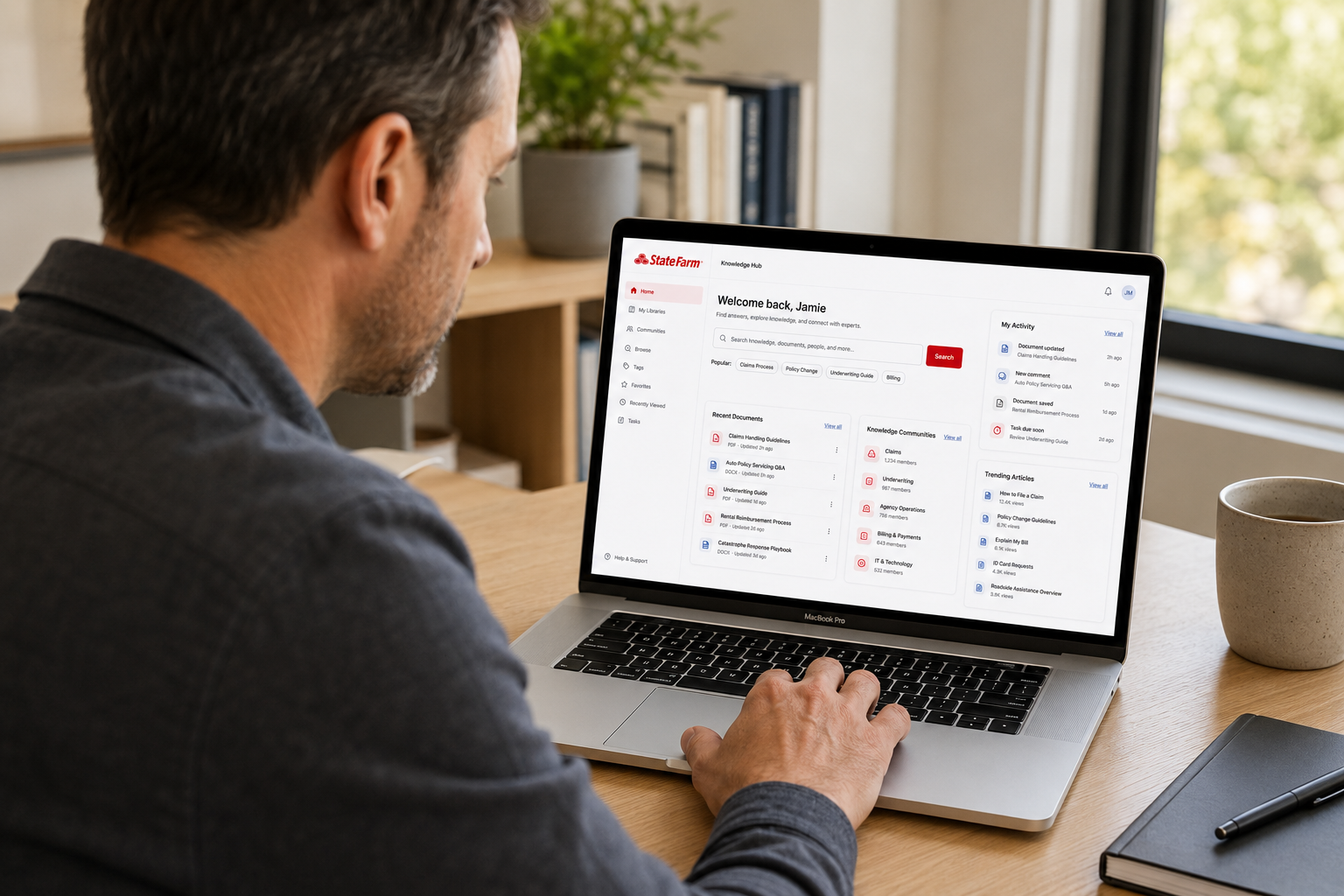
Connecting people to knowledge, and knowledge to action.
I helped employees find useful information, contribute what they knew, and preserve expertise when someone changed roles or left the team.
ROLESenior UX Designer
METHODSUser interviews · Workflow analysis · Personas · Journey mapping · Information architecture · Dashboard design
PROBLEM
People couldn’t always find the knowledge they needed.
Documents, code, and resources were spread across different places. Some knowledge was never written down and could leave with experienced employees.
Engineers needed quick access to accurate, current information.
Technical resources lacked a centralized, navigable home.
Expert knowledge was being lost during role changes and departures.
APPROACH
Start with how people work, not where content lives.
I studied how employees found documents, asked for help, and shared experience, then used personas and journey maps to connect discovery with contribution.
01
Understand
Find where fragmented resources and knowledge loss interrupted daily work.
02
Define
Use Simone and Bill to keep new and experienced employees in focus.
03
Map
Trace discovery, delivery, and contribution across tools.
APPROACH · MARKET RESEARCH
Review the existing knowledge ecosystem.
I reviewed the current hub, search, document, community, and work-management touchpoints to understand where context was lost between systems.
APPROACH · USER INTERVIEWS
Three needs kept coming up.
Interviews with engineers and product employees showed that speed, trust, and continuity mattered as much as search.
01
Relevant answers
Engineers wanted instant results tied to their work.
02
One starting point
People needed organized access to technical resources.
03
Knowledge continuity
Teams wanted expertise to remain available after employees left.
APPROACH · USER PERSONA
A new engineer and an experienced product lead needed different starting points.
Simone helped me examine onboarding and trust. Bill helped me consider exploration, alignment, and continuity across a longer product journey.
APPROACH · USER JOURNEY
Switching tools often meant losing context.
The journeys connected finding knowledge, applying it to delivery, and contributing what was learned for the next person.
01
Discover
Find a trusted starting point.
02
Apply
Use knowledge in the work.
03
Contribute
Share context and examples back.
SOLUTION
Bring resources together and make sharing easier.
The redesigned hub connects search, recent activity, technical resources, contribution templates, and guided tacit-knowledge transfer.
01
Central hub
Inline search and categories make useful content easier to find.
02
Contribution dashboard
Drafts, templates, ownership, and review support reusable knowledge.
03
Tacit knowledge transfer
Guided prompts capture responsibilities, relationships, risks, and successors.
RESULTS
Less time searching, more knowledge shared.
01
40%
Reduction in search time
02
30%
Increase in knowledge sharing
03
1 hub
A connected starting point
KEY LEARNINGS
Access matters. So does the experience around it.
01
Collaboration
People need to work through answers together.
02
Personalization
Role-relevant starting points improve usefulness.
03
Continuity
Knowledge should be easy to find, use, and pass on.
NEXT STEPS
Continue improving the system with employees.
Next steps include testing AI-assisted recommendations, role-based customization, and deeper enterprise-tool integrations.